Thursday, February 2, 2017

Ignorance of the Risk Is No Excuse


A previous note offered a quarterly executive risk review as a simple and pragmatic way to start a risk management program.  A risk review fits naturally into the agenda of the quarterly business review, and it lays a good foundation from which to evolve a risk management program of whatever sophistication and at whatever pace is desired.


The first thing that will come out of the risk review is, “What do we do now to manage our top risks?”  A future note will explore the four general methods of treating risk.  But first we’ll look at the pros and cons of willful ignorance.

There may be a strong inclination to turn a blind eye to some risks.  You may feel that there are some things you do not want to “know” – in quotes because of course you are aware, but you do not want evidence to be created that could come back to haunt you.  Somebody could find that document and require you to address the risk, or worse accuse you of negligence, because there is evidence that you knew of a risk, or should have known, and did nothing about it. 

Management can take a willful-ignorance approach.  But let’s look at the balance sheet. 


There are a few points on the plus side. The executive may have plausible deniability for a time, and gain some time to address many other pressing issues first.  She or he may even get away with doing nothing indefinitely.  In a fledgling enterprise, the executive may calculate that it is more important to establish that the business is viable than to manage certain risks.  If there is no business, risk doesn’t matter.

There are more points on the minus side.  The trend in the investment, risk management, and regulatory environments is toward less patience with ignorance of risk.  All risk management frameworks require regular executive review of risk.  It is an important part of corporate governance.  Big customers and regulators will demand a risk management program.  Investors too want to understand their risk before committing funds to your enterprise, and cyber risk is now prominent in everybody’s awareness.  Especially bankers!

Furthermore, it may not make good management sense to ignore a risk.  Most risks do not get better with time, and some can blow up to jeopardize the very existence of the company.  Imagine a breach of confidential data just when you are trying to sign that first marquee customer.  Finally, there is value in being able to sleep at night, and knowing what your problems are is better than worrying about what they may be.

Turning a willful blind eye to a risk -- “rejecting” it -- is not the same as knowingly accepting a risk, which may be the best way to treat it.  It is management’s decision whether to treat or reject a risk, but rejecting is not a winning strategy in the long run.

Friday, January 27, 2017

The Executive Risk Review


If this sounds like Management 101, it is.  It is the same kind of management control system that is used to manage financial metrics.  The only thing that might be new is applying the idea to risk. 

Meeting the demands of key customers and regulators to manage cyber risk is yet another challenge for the executives of small and medium businesses.  As if you needed one more thing to worry about, along with revenue, product, and cash flow!  Yet it is possible to make a credible, practical, and above all useful start on managing cyber risk without breaking the budget or getting mired in endless detail.  A simple way to get started is with a quarterly risk review.  Here is how to go about it -- without buying a Lexus when all you need is a Corolla.  This will work for any organization, whether a business or not, that is big enough to have quarterly business reviews.

Simply this:  add a risk review to the standing agenda of the quarterly business review.  A risk review addresses three basic questions:
  • What are the most important risks facing the company in the next 12 months?
  • Are these risks acceptable to management and the owners, given our current circumstances, or should we be doing something to manage those risks better?
  • What action should we now take to manage our top risks better, and what progress have we made in actions previously agreed?  Who will take responsibility to do them, and when should they be complete?  How will we know if they have been effective? 

 As management exercises its judgment about what the most important risks are and what to do about them, it is automatically setting risk management priorities.

Despite its simplicity, this approach has much to recommend it.
  • It makes management think consciously about risk.  That is the first step in managing it.
  • It establishes a recurring and repeatable routine.  That lays the groundwork for bringing almost any risk into acceptable bounds.
  • It results in decisions and actions, so it gets things done, in priority order.
  • It is a structure that can be matured over time to any level of sophistication.  Soft words like “important risks” can be made more objective and quantified.
  • It is very efficient, a good use of scarce executive time, once the cadence is established.
  • It shows that management is paying attention to risk.

“Paying attention” deserves some elaboration.  Sooner or later a key stakeholder will insist on having assurance that management understands its risks and is managing them.  Stakeholders include the board, current and prospective investors, key customers, regulators, and auditors.  To credibly assert that, “Yes, we do know our risks, we review them regularly, and we take appropriate action to manage them,” you can do a few simple things to create auditable evidence that your stakeholder with expect or insist upon.
  • Put “risk review” formally on the agenda of the meeting.  (Every business review should have a written agenda.)
  • Prepare a simple two-page “risk report” ahead of the meeting and discuss it.  It can even be an email to the management committee.  The CFO, VP Finance, or CIO might be responsible to prepare it. 
  • Document the results of the risk review in the meeting minutes.  (Yes, have minutes!)  This can be as terse as a note that risks were reviewed and certain actions were assigned.  Cite the risk report and say it was reviewed.

The secretary of the meeting, who could be one of the participants or an administrative assistant, should be responsible to collect, organize, and preserve these documents, so that they can be audited later.  All documents should be dated and bear evidence of having been distributed to relevant executives, such as by email.


Another note will get into what a risk report should have.

Friday, January 20, 2017

Overcoming the Cyber Security Hurdle for SMBs

You have a brilliant concept for a new product or service.  You’ve gotten funding and created the core of a great team.  To see you dreams become reality, you willingly pay the price of 80-100 hour work weeks.  But sometimes it seems the rule-makers are doing everything they can to get in the way.  This time it’s cyber security.

Finally, you have your first big customer lined up, and here comes their due-diligence team.  They send you a questionnaire with hundreds of items about cyber security, backups, disaster recovery, encryption, and myriad other arcana. It is a sobering moment.  Your customer takes this seriously because they’ve been whacked by their regulators after a nasty and all-too-public data breach.  The information risk management folks are in no mood to compromise, having gotten the word that if there’s another breach heads will roll. 

What does it take to satisfy IRM and win the business?  All it takes, it seems, is answering Yes to 400 detailed questions like “Do you do background checks on all employees?” and “Do you protect all your critical data with strong encryption?” – most of which you have never thought about before.  On top of that you “must have” certification of your security controls by an independent third party, like a SOC2 or ISO 27000 audit.  Then you learn that the next customer has its own requirements.

It’s enough to drive one mad.

You need a strategy to address this big new business risk, and quick!

In a series of notes like this one, I’ll give the small-medium business executive some practical tips on how to meet these challenges in a rational, businesslike way – without going either broke or crazy.  What is easily lost in the technical minutiae and, lately, the fear, uncertainty, and doubt about cyber security, is that managing cyber risk boils down to the same basic management principles you use in the rest of your business.  My aim is to show you how to apply those principles in a simple and intuitive way, so you can focus on growing your business.

The first step is to know your risks, and that will be the next topic.

Thursday, July 30, 2015

Managing the Inevitable Cyber Losses

There have been many breaches recently in each of which tens of millions of Americans have had their person information compromised.  New ones are all too frequent.   And in several of the most notorious recent cases, months and even years have elapsed before the breach was discovered and dealt with.  The attackers are evolving new threats faster than defenders are reacting – and to some extent faster than they can react in today’s world. 

We can draw three conclusions from this trend. 

First, since it appears highly likely that this tide of personal-information disclosures will continue, organizations must become much better at incident response.  It seems that the information security profession has placed higher priority and put more resources into prevention and detection – especially in technology – than in incident response.  One can speculate why this would be so, but the fact remains that the magnitude of loss increases with the time taken to effectively respond.  Therefore, since breaches will remain inevitable for the foreseeable future, the key to managing the magnitude of the losses is to respond rapidly and effectively.  If you can’t prevent holes in the boat, at least plug them fast.

Second, we have to become much better at detection.  This means not only detecting a breach or intrusion that has already occurred, but also detecting its precursor events.  Thanks to Lockheed-Martin’s application of kill-chain analysis to cyber breaches, we now understand more clearly that exfiltration of data is a multi-phase affair that requires success in several steps in sequence, and therefore may take weeks or months to pull off.  This gives the defender two advantages, the advantage of multiple ways defend against and multiple ways to defeat an attack, and the advantage of time to do so.  But that depends on an ability to detect anomalous events when they occur, as well as on an effective capacity to respond quickly.  So organizations must become better at detecting anomalous events.  But crucially “detection” does not stop with some piece of technology logging an event or even firing off an alert.  A person has to make a determination that “We got a problem here, Houston,” and get resources dispatched to deal with it.

This brings us to the final point.  Detection and logging systems are famously inundated with thousands or millions of false positives and irrelevant alerts for low-level threats.  This situation is made to order for susceptibility to well-known human failings of inattention and fatigue.  It is a mystery why, in a profession and an industry so imbued with technology, better technology is not available to dramatically increase the signal-to-noise ratio, and do it cheaply (which means it cannot depend on having expensive security engineers continuously tweaking rules). 

Here are some action take-aways:
1.       CISOs:  Review and test your incident response plans.  Does your IR plan address the highest-priority threat scenarios?  Try exercising it on “garden-variety” incidents, like lost laptops, to see if it works and how it can be improved.  Hold at least a table-top test once a year.

2.       CIOs and CISOs:  Review the balance between investments in security technology (SIEMs and IDPSs for example) and the funding for their effective use once they are installed.  Do not fall victim to the set-and-forget fallacy in which, once a system is installed, one thinks “well, that problem is solved now.”  Do you have capable staff assigned to manage the technology, and do they have the training, the time, and the management expectation to do the job?

3.       Security technology suppliers:  Create products and services for your customers to initially configure their detection devices with good starter sets of filtering rules and keep them updated frequently.  IDPS operators should be able to get updates at least daily to threat signatures discovered by, at least, all owners of similar equipment, but ideally the entire security community.

4.       Legislators, staff aides, and policy analysts:  Give us laws that protect organizations, especially corporations, from liability if they contribute threat signatures to a common repository.  The low-bandwidth, high-latency sharing of information security knowledge that occurs in conferences and white papers is fine, but it needs to be complemented with daily operational updates.  If a small but critical mass of organizations contributed in near-real-time to a common repository of threat signatures that was available to all, the time from threat discovery to effective defense could be dramatically reduced.  This is one way to turn the asymmetry of the threat against the attackers.


Wednesday, May 27, 2015

FAIR Lessons of the Amtrak Accident

FAIR can be extended to the analysis of risk scenarios that have multiple impact variables, such as in public safety.  This note reports lessons learned from a simple model inspired by the Amtrak crash.

Introduction
The crash of an Amtrak passenger train in Philadelphia (5/13/15), which killed 8 and injured over 200, offers an opportunity to analyze the risk of such situations and consider the investment case for positive train control.  According to NTS Board member Robert Sumwalt PTC “would have prevented the accident if it was operational.” 

Despite “information” in its name, FAIR is a useful and appropriate tool for analyzing many kinds of risk other than information risk.  Let us take this opportunity to apply it to transportation safety.

FAIR has a big drawback, at least as it is typically used.  The result of a FAIR analysis is an estimate of annual loss expectancy (ALE), which is presumed to be measurable on one dimension, inevitably money.  But when matters of public safety are involved, as with transportation and health care, money is only one consideration.  Loss of life, injury, and long-term impairment of quality of life (which together I call life safety) are outcomes that cannot be adequately expressed in money terms, for reasons emotional, philosophical, and political.  Therefore any risk analysis of a transportation or health care scenario must include life safety in addition to financial loss.

One way to assess risk in such a multidimensional outcome scenario is to do a FAIR analysis of each outcome variable separately.  The deliverables to the decision maker is then (1) the ALE for financial loss (2) the ALE for life safety loss and (3) some depiction of how the two ALEs correlate.  It is then up to the decision maker to process these analytical results and set priorities for investment, just as in the case of a purely financial impact the decision maker must decide which of two ALEs is preferable, or whether the investment needed to move from one ALE to another is justified. 

In this note I report on the experience of such a modeling effort, inspired by the Amtrak accident.   I find some interesting and useful insights from using FAIR in this way.

Model Structure

I constructed two simple and nearly parallel FAIR risk analyses of a passenger train risk scenario similar to the May 13 2015 Amtrak crash in Philadelphia.  The main goal of the analysis was to test the ability of the FAIR ontology to support the analysis of a risk scenario having two important impact variables, financial loss and life safety.  This goal makes little demand for representational accuracy of the actual train crash scenario, so the model is simple.  Each impact variable, financial loss (ALE) and life safety loss (expressed as ALE of lives lost), was analyzed using the FAIR ontology.  The two analyses are nearly independent, having only the threat event frequency and the probability distribution of lives lost as a common driver, and in that sense are “nearly parallel.”  The model structure is shown in the following figure.  Lives lost drives fines and judgments as well as being a thing of value in its own right.

Figure 1.  Structure of a FAIR Model with Two Impact Variables.

I used what I considered to be plausible values for parameters of the probability distributions, all of which were of the PERT family.  I do not believe the main lessons of the analysis depend in any meaningful way on the values of the parameters, so I omit discussion of the choices of parameter values.  Likewise the model could easily be built out in considerably more detail without materially changing the results.  Monte Carlo simulation with 1,000 trials was used to model the effect of the several random variables. 

Results
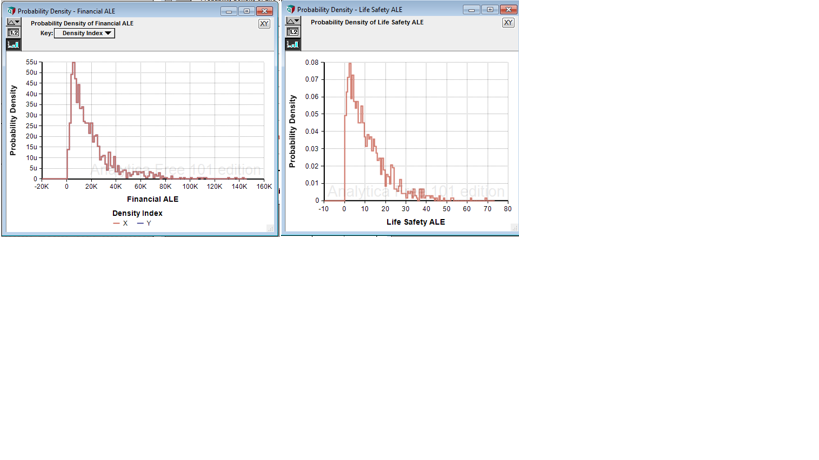
The next two figures show the simulation results for the probability distributions of annual loss expectancies for financial loss and life safety (i.e., lives lost).  (Note that financial loss is measured in $K, so the abscissa for financial ALE is actually $M.)

Figures 2a and 2b.  Financial and Life Safety ALE

The decision maker has one budget to allocate to mitigate both risks, so a very pressing question is whether, and to what degree, mitigating one also mitigates the other.  Do they vary together or opposite to each other?  The next chart is a scatter plot of the simulation results.  Each dot is one MC trial.

Figure 3.  Scatterplot of Financial and Life Safety ALEs.  Each dot is a simulation trial.

Not surprisingly, financial loss and life safety are highly correlated.  This makes intuitive sense since each life lost imposes a risk of lawsuits and settlement costs on the railroad.  However the degree of correlation becomes weaker at higher levels of loss.  If there is any good news for the railroad, it is that spending money to reduce financial loss also tends to reduce life safety loss.

The Counterfactual Scenario
The reason that financial ALE and life safety ALE are so strongly correlated is the high value I put on a lost life (PERT with minimum, most likely, and maximum of $500K, $1000K, $5000K per life).  To test how strongly life safety loss drives financial loss, I constructed a counterfactual model which puts the financial loss of a lost life at zero.  In this structure the connection from Secondary Financial Loss Magnitude to Financial ALE was simply removed.

Figure 4.   Counterfactual Model.  The railroad has no liability for lives lost.

The correlation between the two impact variables now looks like this:

Figure 5.  Scatterplot of Financial and Life Safety ALEs when the railroad has no liability for lives lost.

The correlation is still positive because the worse the accident, the more lives lost and the more equipment destroyed, but looser. 

Conclusions

1.       FAIR can be used, quite straightforwardly, to analyze the risk of scenarios that have multiple impact variables.  What needs to be added is some analysis of how the various loss expectancies relate to each other.  Tradeoffs among ALEs of multiple impact variables is left to the decision maker, or to another analysis.

2.       Making the railroad (or in general the provider) liable for non-financial losses imposed on secondary stakeholders tends to align multiple risk measures in the decision making of the provider.  The greater the liability to the provider, the better the alignment.  This is obvious but the model illuminates the degree to which, and the manner in which, the alignment is created

3.       Therefore modeling of this sort can be useful for public policy analysis.  It could be used to explore different kinds of transfer of liability from secondary stakeholders to the primary stakeholder, and different levels of absolute liability (e.g. should there be limits on the valuation of a life, and what might they be?)

4.       This kind of multi-impact risk analysis can be useful in many kinds of public policy analysis involving risk other than transportation safety, such as health care, pollution, water allocation, earthquake and extreme storm hazard mitigation, and defense planning.